• Evidence-Informed Guide · Updated 2026

Your magnesium questions.
Finally answered.

Many people do not meet recommended magnesium intakes. Fatigue, poor sleep, and muscle tension have many possible causes, so low magnesium should be considered in context rather than assumed.
Primary benefit

Daily magnesium intake support; may support sleep in some people, though the evidence is still limited

Also: muscle, energy, bone, nervous system

Also known as

Magnesium Bisglycinate

Same compound, interchangeable names

GI tolerance

Often chosen for digestive tolerability

Gentler than oxide or citrate forms

Supplement upper limit

350 mg/day elemental Mg

Food sources excluded from this limit

Verified standards

• Evidence-Informed Content
• cGMP Certified Manufacturing
• Reviewed by Registered Dietitian
• Third-Party Tested
300+
Enzyme systems in the body rely on magnesium for normal function.
Source: NIH Office of Dietary Supplements
48%
Of Americans consume less magnesium than the estimated average requirement.
Source: NIH, NHANES data
4wks
2025 RCT found a small, statistically significant reduction in self-reported insomnia severity with magnesium bisglycinate.
Source: Randomized controlled trial, 2025

The Basics

What is
Magnesium glycinate?
Magnesium glycinate (also called magnesium bisglycinate) is a form of magnesium supplement in which magnesium is chemically bound to glycine, an amino acid. The two names refer to the same compound and are used interchangeably. Magnesium is involved in more than 300 enzymatic reactions in the body: energy production, nerve and muscle signaling, blood sugar regulation, bone formation, and the maintenance of normal heart rhythm.
Two active components: The magnesium supports hundreds of physiological systems. Glycine functions as an inhibitory neurotransmitter, upporting the conditions that allow the nervous system to settle toward a calmer baseline but the extent to which the glycine ligand contributes to clinical effects independently of magnesium bisglycinate is not well established.
Magnesium glycinate is specifically chosen because it is well-tolerated by the digestive system, making it practical for consistent, long-term daily use, unlike oxide or citrate forms, which can have a laxative effect at higher doses, though GI side effects can still occur and vary by dose and formulation
Woman sleeping in a white bed with a large ornate mirror and a tray with tea and snacks on a wooden floor nearby.
Nutritionn Magnesium Glycinate for Gut
Nutritionn Magnesium Glycinate for Hearth
Close-up of beige capsules spilling from a white bottle with green leaves in the background.
What magnesium does
in the body
White tick icon
Supports ATP energy production in every cell
White tick icon
Regulates muscle contraction and relaxation
White tick icon
Participates in neurotransmitter synthesis and nerve signalling
White tick icon
Helps maintain normal blood sugar regulation
White tick icon
Contributes to bone mineral density and formation
White tick icon
Supports normal heart rhythm and cardiovascular function
White tick icon
Regulates calcium and potassium balance
White tick icon
Involved in protein and DNA synthesis
Important: Elemental Magnesium
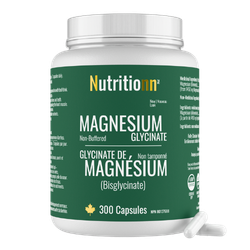
Always check for elemental magnesium on the label, this is the amount of elemental magnesium the supplement provides, not the compound weight; actual absorption varies. A 1,000 mg bisglycinate capsule typically provides only ~140 mg elemental magnesium. Nutritionn Magnesium Glycinate uses ~1,540 mg of non-buffered magnesium glycinate per capsule, delivering 212.5 mg elemental magnesium. Always compare products on this number.
Read the full guide ->

Why It Matters

The magnesium
difference
Not all magnesium supplements work the same way. Here is why the glycinate form stands out for daily use.
1
Fully chelated
Magnesium is bound to glycine; both are biologically relevant molecules, but their separate clinical contributions in this form are not fully established.
2
Gentle on digestion
May be less likely than some forms to cause loose stools at typical supplemental doses, but tolerance varies by person and dose.
3
May support restful sleep
In one 2025 4-week RCT, magnesium bisglycinate produced a small, statistically significant reduction in self-reported insomnia severity.
4
Supports energy metabolism
Essential for ATP synthesis, the cellular energy currency. Participates in over 300 enzymatic reactions, including how your body converts food into usable energy.
5
Bone and muscle health
Approximately 60% of the body's magnesium is stored in bone. Plays a direct role in muscle contraction and relaxation, relevant for cramps and persistent tension.
6
Transparent dosing
Elemental magnesium is what matters on a label, not compound weight. Understanding this number is the first step to choosing a supplement that actually delivers.
Who It's For

Navigate magnesium with the right guidance

Magnesium glycinate may be most relevant when dietary intake is consistently low, or when specific conditions or lifestyle factors make maintaining adequate levels more difficult.

Nutritionn Magnesium Glycinate for Gut 2

GI conditions

People with Crohn’s disease, celiac disease, or chronic diarrhea may be at higher risk of magnesium inadequacy because absorption can be reduced and losses can increase.

Type 2 diabetes

People with type 2 diabetes may lose more magnesium in urine; this does not mean magnesium supplements treat diabetes or improve glycemic control.

Nutritionn Magnesium Glycinate for Blood Sugar
Nutritionn Magnesium Glycinate for Older Adults

Older adults

Absorption declines with age while excretion increases. Dietary intake is also frequently lower in older populations.

Getting Started

Three steps to
building your routine.
01
Understand the dosage

Always look for the elemental magnesium amount on the label, this is the elemental magnesium the supplement provides per serving; absorption varies. A cautious approach is to start with a lower supplemental dose and adjust to tolerance, depending on the product format and clinical context. In U.S./Canada-aligned guidance, the adult upper limit is 350 mg/day from supplements and medications, excluding food. Flexible dosing matters: start low, go slow.

arrow pointing right
02
Choose your timing

For sleep and relaxation support, many people take magnesium glycinate in the evening or 1-2 hours before bed. For muscle support during active periods, splitting between morning and evening may improve tolerance. Taking it with food works well for most people.

arrow pointing right
03
Be consistent, be patient

Benefits from magnesium glycinate tend to be subtle and cumulative, not immediate or dramatic. If you choose to use it, reassess after several weeks; any benefit depends on baseline intake/status and the outcome you’re tracking. Higher doses are not always better, consistency matters more.

Our Recommendation

If you're looking for a
supplement

We recommend products that meet the standards discussed in this guide: elemental dose transparency, clean formulation, and verified quality manufacturing.

Nutritionn ottle of Nutritionn Magnesium Glycinate supplement with 300 capsules, providing elemental magnesium for nutritional support.
Editor's Pick · 2026

Nutritionn Magnesium Glycinate

Non-buffered · Fully chelated bisglycinate · NPN 80091342

Elemental Mg
212.5 mg per capsule
Source
100% Magnesium Glycinate (Bisglycinate)
Other ingredients
Hypromellose (capsule) only
Origin
Made in Canada · cGMP Certified

We recommend this product because it meets our editorial criteria: single active ingredient, transparent elemental dosing, non-buffered fully chelated form, and licensed for sale as a natural health product in Canada (NPN 80091342), which may be a useful Canadian regulatory marker for some buyers.

MagnesiumGlycinate.org is published by the team behind Nutritionn.com. Product recommendations reflect our own formulation and quality standards.

Your Choice

Two ways this can go.

Common reasons people look into magnesium

What adequate magnesium intake may support

Sleep that feels less restorative than it should
Normal sleep physiology
Energy that stays consistently low
Energy metabolism
Muscle tension or cramping
Normal muscle function
Uncertainty about whether dietary intake is adequate
Meeting daily nutritional needs
50-60%
of body magnesium is stored in bone, most of the rest is in soft tissues, and less than 1% is in blood. Serum magnesium may not accurately reflect total body magnesium status.
Close-up of a plant stem with elongated pink and green leaves against a deep blue background.
Register Dietititan Zeynep Ozdemir
quote mark
Knowing what you're taking, why you're taking it, and how it fits your body is often the most valuable part of the choice. Magnesium glycinate may help support the physiological conditions that allow the nervous system to shift toward a calmer baseline, not as a cure, but as a tool that can be useful in the right context.
Zeynep Ozdemir
Registered Dietitian · Expert Reviewer
Evidence-based nutrition, straight to your inbox.
Written and reviewed by registered dietitians, practical insights on nutrition, supplementation, and health. No marketing, no filler. Delivered occasionally.
Person wearing a hooded jacket and gloves holding a laptop, appearing in a dark setting.Have a specific question? Ask our registered dietitian →