
This guide compares common magnesium forms the way a careful reader actually needs them compared. It starts with label math, explains what organic and inorganic mean in magnesium chemistry, and then works through the real trade-offs: tolerance, elemental density, solubility, cost, capsule size, and the quality of the human evidence.
There is no single best magnesium form for everyone. The useful question is which form fits your goal, your GI tolerance, and the amount of elemental magnesium you can actually sustain. Glycinate is often chosen for daily routine use, citrate makes more sense when bowel regularity matters, oxide is extremely dense in elemental magnesium and often shows up in buffered formulas, chloride is well-solubilized, and L-threonate is the main brain-and-sleep niche form with a recent modern trial program.
The fastest way to orient yourself before you read the long version.
The first number to compare is elemental magnesium. The second question is what form the magnesium is attached to. Everything else comes later.
Most magnesium form articles jump straight to ranking winners and losers. That is backwards. Before you compare glycinate, citrate, oxide, chloride, or L-threonate, you have to compare like with like. NIH makes this point clearly: the Supplement Facts panel lists elemental magnesium, not the full weight of the magnesium-containing compound.1 That means a product with a bigger compound-weight number is not automatically the stronger dose in any meaningful way.
This is especially important with glycinate. A theoretical figure of about 14% elemental magnesium is often quoted for a fully reacted non-buffered glycinate, but real commercial labels do not always reach that ceiling. In the real world, many glycinate labels fall closer to roughly 10% to 14% elemental magnesium. That is why a forms page should teach label literacy before making any form-to-form claims.
Pick the form based on your goal and tolerance. Pick the dose by elemental magnesium. Those are two related decisions, but they are not the same decision.
In supplement chemistry, organic does not mean farmed like organic produce. It means magnesium is attached to a carbon-containing ligand such as glycine or citrate. Inorganic forms include salts such as oxide, chloride, and sulfate.
This distinction confuses readers because the word organic already means something else in food culture. On a magnesium label, however, organic and inorganic refer to the chemistry of the salt or chelate. Glycinate and citrate are generally grouped under organic forms. Oxide and chloride are commonly grouped under inorganic forms. The 2021 systematic review by Pardo and colleagues concluded that organic forms were generally more bioavailable than inorganic forms, but it also emphasized that dose, solubility, and formulation still matter.2
That last part matters because people can overread the organic-versus-inorganic language. Organic does not mean automatically superior for every use case. Inorganic does not mean useless. Oxide is a good example: it is less well absorbed than several other forms in common guidance, but it is very dense in elemental magnesium and therefore useful in some formulations.12
Chloride is called inorganic in the magnesium literature because chloride is not a carbon-containing ligand. That does not mean it is automatically “worse” than every organic form. It means the comparison has to be made on actual outcomes such as solubility, tolerance, and the reason the person is taking it.2
Because magnesium oxide helps fit more elemental magnesium into a smaller capsule. Cost is part of the story, but it is not the whole story.
Buffered magnesium formulas often mix glycinate with oxide. The usual consumer narrative is that this is done only to save money. That can be true, but it leaves out an important formulation reason. Magnesium oxide is about 60% elemental magnesium by weight from straightforward chemistry, so it is extremely efficient if the manufacturer wants a higher elemental number in fewer capsules. That can improve capsule size, reduce daily capsule count, or make the label look stronger at a glance.
The trade-off is that official NIH guidance and the 2021 systematic review both place oxide below several other forms for absorption, and NIH also lists oxide among the forms more commonly reported to cause diarrhea.12 So a better forms page does not shame buffering. It explains the trade-off honestly: higher elemental density and smaller capsule footprint on one side, but potentially rougher GI tolerance and less favorable absorption on the other.
Buffered formulas are not automatically low quality. They are a design choice. Whether that choice is smart depends on the user’s goal: elemental density, budget, capsule size, GI tolerance, or daily routine comfort.
No single form is best for every person. The useful question is which form best fits a specific goal, such as gentle daily use, constipation support, capsule efficiency, or a brain-marketed niche.
Supplement marketing loves a podium. Human biology usually does not. The best-supported way to compare forms is to stop asking for one universal winner and instead ask a narrower question: what are you trying to do, what dose can you tolerate, and which form has human evidence that actually matches that goal? That is a more honest framework and it also maps better to the literature. NIH guidance provides a broad absorption hierarchy, but the more detailed review literature still shows dose-dependent absorption, form-dependent tissue behavior, and big differences in study design.12
In other words, “best magnesium form” is often the wrong question. “Best fit for purpose” is better. For gentle day-to-day use, glycinate often gets chosen because it is widely perceived as easier on the stomach. For bowel regularity, citrate makes more intuitive sense. For getting a lot of elemental magnesium into a small serving, oxide is efficient. For a sleep or cognitive product trying to differentiate itself with a brain-directed story, L-threonate is the main niche form with a recent human trial program.1367
If you want a routine form that many people find gentler, glycinate is often the practical pick. If bowel regularity is part of the goal, citrate is often the more intuitive choice.
Citrate is one of the forms NIH lists among the better-absorbed magnesium salts, and it is also one of the forms consumers often notice in digestive or bowel-focused products.1 That can be a feature or a bug depending on the person. Someone who wants a little help with constipation may like that profile. Someone who wants a calm nightly routine without any laxative lean may prefer glycinate.
Glycinate gets a lot of consumer attention because glycine itself has a sleep-friendly reputation and because many users describe the form as gentler. The problem is that head-to-head human data between glycinate and citrate for the exact same outcome are still limited. So the most honest comparison is practical, not absolute: citrate is often the more logical bowel-focused form, while glycinate is often the cleaner daily-use form when you want to avoid pushing stool looseness.2
Oxide wins on elemental density and usually on price. Glycinate usually wins on daily-use feel and overall consumer friendliness.
If your only goal is to put the biggest elemental magnesium number possible into the fewest capsules, oxide is efficient. Because magnesium oxide is about 60% elemental magnesium by weight, it can deliver a lot of magnesium in a compact format. That partly explains why oxide appears so often in buffered formulas and lower-cost products.
The trade-off is familiar by now. NIH states that oxide is absorbed less completely than several better-solubilized forms and lists it among the forms more commonly associated with diarrhea.1 The 2021 systematic review reaches a similar conclusion at a broader level, placing inorganic forms below organic forms overall in bioavailability.2 So oxide is not useless, but it is often a less elegant fit for someone who is specifically seeking a gentler everyday routine.
People sometimes mistake a higher elemental number for a better form. A higher elemental number can be a real advantage, but only if the person can tolerate the formula and the chosen form aligns with the reason they are taking magnesium in the first place.
Chloride is usually discussed as a well-solubilized, reasonably well-absorbed inorganic form. Glycinate is more often chosen when the user wants a chelated form with a calmer daily-routine reputation.
NIH includes chloride among the forms that tend to have higher bioavailability than oxide and sulfate.1 That makes chloride more interesting than people sometimes assume when they hear the word inorganic. At the same time, chloride is also one of the forms NIH lists among those more commonly associated with diarrhea at higher intakes.1
In practical supplement shopping, chloride is less often the “lifestyle favorite” and more often the physiologic or solubility-oriented option. Glycinate, by contrast, is more often the form people reach for when they want something that sounds gentler, feels more premium, or is being used in a sleep-support context. Again, that is a positioning difference as much as a chemistry difference.
L-threonate is the main “brain and sleep” niche form with a recent modern trial program. The evidence is interesting, but it is not a reason to call every other form outdated.
L-threonate has become the most visible specialist magnesium form because it is marketed around brain delivery and cognitive support. It also has a more recent human sleep-trial program than most other forms. In 2024, Hausenblas and colleagues reported improvements in several subjective and Oura-based sleep measures after 1 g/day of magnesium L-threonate for 21 days in adults with self-reported sleep problems.6 In 2026, Lopresti and Smith found some subjective sleep-related improvement with 2 g/day of Magtein in adults with dissatisfied sleep, but no clear overall group differences in objective Oura sleep outcomes.7
That pattern matters. It suggests L-threonate is worth taking seriously, but it does not justify sweeping claims that it is simply “better for sleep” than glycinate, citrate, or every other form. The evidence is newer and more focused, yet still mixed. A responsible forms page should present that as a promising niche rather than a crowned champion.
The key studies do not all answer the same question. Some tell you about absorption. Others tell you about sleep outcomes. A good comparison page keeps those categories separate.
Adults with poor sleep took 250 mg elemental magnesium as bisglycinate daily for 4 weeks.
Insomnia severity improved more than placebo, but the effect size was small.
The review found observational signals that looked more favorable than the intervention evidence.
Its bottom line was cautious, not promotional.
Participants with self-reported sleep problems took 1 g/day of magnesium L-threonate for 21 days.
The study reported improvements in subjective and some objective sleep measures.
After 6 weeks of 2 g/day, some subjective sleep-related outcomes improved, but objective Oura sleep outcomes did not clearly separate from placebo overall.
Organic forms were generally more bioavailable than inorganic forms, and absorption tended to drop as dose increased.
The review also emphasized that all forms can maintain physiological levels in healthy people, which is an important anti-hype reminder.
The key studies do not all answer the same question. Some tell you about absorption. Others tell you about sleep outcomes. A good comparison page keeps those categories separate.
Read the label in three passes: elemental amount, actual form, then whether the formula is blended or buffered.
That is the number that makes cross-product comparison possible.
Glycinate, citrate, oxide, chloride, or L-threonate each signals a different trade-off profile.
If oxide is part of the formula, the product may be using elemental density to raise the magnesium number in a smaller serving.
Organic and inorganic here refer to ligands and salts, not to organic agriculture.
The best purchase is not the one with the biggest front-label number. It is the one whose trade-offs line up with the job you want it to do.
Most comparison mistakes are tolerance mistakes, not exotic toxicity mistakes. The usual problems are diarrhea, cramping, nausea, and taking more supplemental magnesium than you realized because the label was confusing.
For healthy adults, too much magnesium from food is usually not the issue. The main concern is magnesium from supplements and magnesium-containing medicines. NIH keeps the current adult upper limit for supplemental magnesium at 350 mg per day and notes that excess from supplements or medications commonly causes diarrhea, nausea, and abdominal cramping.1
That is why form choice matters so much. Oxide can be very efficient on paper because of its elemental density, but that same efficiency does not guarantee a comfortable real-world experience. Citrate may be very helpful in the right bowel-focused context, yet the very property that helps one person can make it less appealing for someone else. Glycinate can be a smoother routine form, but it still has to be dosed intelligently and read through the elemental line, not the front-label compound weight. L-threonate may be compelling for some niche brain and sleep goals, but it is not a shortcut around the rest of the dosage and safety conversation.
If you have kidney disease, significant heart disease, or use prescription medicines with mineral timing restrictions, choosing a magnesium form should not be treated like a casual lifestyle quiz. It becomes a clinician-guided decision.1
In everyday supplement language, yes. The two names are commonly used for the same chelated form. What matters more than the name on the front is the amount of elemental magnesium listed on the Supplement Facts panel.1
There is no single universal winner. NIH guidance and the 2021 systematic review suggest that forms that dissolve well in liquid, including citrate and chloride, tend to absorb better than oxide, while organic forms overall often outperform inorganic ones. But dose and product design still matter.12
Because it is cheap and very dense in elemental magnesium, which helps manufacturers fit more magnesium into fewer or smaller capsules. That does not make it automatically bad. It just means the trade-offs are different.
No. In magnesium chemistry, organic means bound to a carbon-containing ligand such as glycine or citrate. It has nothing to do with pesticide-free farming or organic certification.2
Often, yes. Citrate is one of the more practical forms to consider when bowel regularity is part of the goal. That same profile is why it is not automatically the best fit for every person.1
No. The most useful way to choose is to match the form to the goal, the GI tolerance profile, and the amount of elemental magnesium you actually need.
Use the form on this page. No account required.

Your question is reviewed by a registered dietitian or qualified nutrition professional.
A registered dietitian or qualified nutrition professional will respond by email with a evidence-based response typically within 2–3 business days.
Our Recommendation
We recommend products that meet the standards discussed in this guide: elemental dose transparency, clean formulation, and verified quality manufacturing.
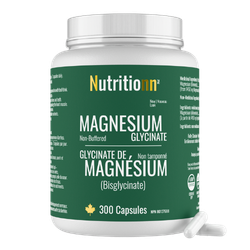
Non-buffered · Fully chelated bisglycinate · NPN 80137688
We recommend this product because it meets our editorial criteria: single active ingredient, transparent elemental dosing, non-buffered fully chelated form, and licensed for sale as a natural health product in Canada (NPN 80137688), which may be a useful Canadian regulatory marker for some buyers.
MagnesiumGlycinate.org is published by the team behind Nutritionn.com. Product recommendations reflect our own formulation and quality standards.
Editorial note:This content is for educational purposes only and does not constitute medical advice. Always consult a qualified healthcare practitioner before starting any supplement, especially if you have a medical condition or take prescription medications. Individual results vary.
References:
1. National Institutes of Health, Office of Dietary Supplements. Magnesium - Health Professional Fact Sheet. Updated January 6, 2026.
2. Pardo MR, Garicano Vilar E, San Mauro Martin I, Camina Martin MA. Bioavailability of magnesium food supplements: A systematic review. Nutrition. 2021;89:111294. doi: 10.1016/j.nut.2021.111294.
3. Schuster J, Cycelskij I, Lopresti A, Hahn A. Magnesium Bisglycinate Supplementation in Healthy Adults Reporting Poor Sleep: A Randomized, Placebo-Controlled Trial. Nature and Science of Sleep. 2025;17:2027-2040. doi: 10.2147/NSS.S524348.
4. Arab A, Rafie N, Amani R, Shirani F. The Role of Magnesium in Sleep Health: a Systematic Review of Available Literature. Biological Trace Element Research. 2023;201(1):121-128. doi: 10.1007/s12011-022-03162-1.
5. Rawji A, Peltier MR, Mourtzanakis K, et al. Examining the Effects of Supplemental Magnesium on Self-Reported Anxiety and Sleep Quality: A Systematic Review. Cureus. 2024;16(4):e59317. doi: 10.7759/cureus.59317.
6. Hausenblas HA, Lynch T, Hooper S, et al. Magnesium-L-threonate improves sleep quality and daytime functioning in adults with self-reported sleep problems: A randomized controlled trial. Sleep Medicine: X. 2024;8:100121. doi: 10.1016/j.sleepx.2024.100121.
7. Lopresti AL, Smith SJ. The effects of magnesium L-threonate (Magtein) on cognitive performance and sleep quality in adults: a randomised, double-blind, placebo-controlled trial. Frontiers in Nutrition. 2026;12:1729164. doi: 10.3389/fnut.2025.1729164.
8. American Academy of Sleep Medicine. A patient guide to understanding behavioral and psychological treatments for chronic insomnia disorder in adults. Accessed April 2026.
9. Costello RB, Rosanoff A, Nielsen F, West C. Perspective: Call for Re-evaluation of the Tolerable Upper Intake Level for Magnesium Supplementation in Adults. Advances in Nutrition. 2023;14(5):973-982. doi: 10.1016/j.advnut.2023.06.008.
Evidence-based articles on magnesium, sleep, stress, and supplementation, written to help you understand what actually matters, without the hype.
.jpg)
.jpg)
.jpg)
.jpg)
.jpg)
.jpg)
.jpg)
.jpg)
.jpg)


.png)
.png)
.png)
.png)