
The Basics

What Is Magnesium Glycinate? Benefits, How It Works & Who It's For

An evidence-informed guide to magnesium glycinate (bisglycinate), what it does in the body, who benefits most, what to look for on a label, and what the current research actually shows.
Reviewed by
Zeynep Ozdemir, Registered Dietitian
Published
2026
Reading time
~8 min
Quick Facts · Magnesium Glycinate
Also known as
Magnesium Bisglycinate
Same compound, interchangeable names
GI tolerance
Often well tolerated
May be gentler than oxide for some people. Comparisons with citrate vary by dose and individual tolerance.
Supplement upper limit
350 mg/day elemental Mg
Adult supplemental upper limit: 350 mg/day in U.S./Canada/Australia guidance (food excluded); UK consumer guidance commonly cites 400 mg/day from supplements as unlikely to cause harm.
Sleep evidence (2025)
Limited but promising
RCT: modest improvement · small samples · mixed findings
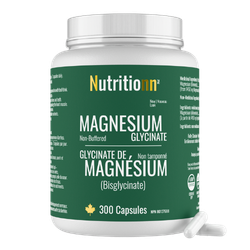
Nutritionn Magnesium Glycinate for Heart
White capsules spilling out of a white bottle next to green leaves on a surface.

Magnesium glycinate, also called magnesium bisglycinate, is a form of magnesium supplement in which magnesium is chemically bound to glycine, an amino acid. The two names refer to the same compound and are used interchangeably on supplement labels worldwide. It is often chosen as a well-tolerated form for routine use, although direct head-to-head comparisons with other organic salts remain limited.

Magnesium is involved in more than 300 enzymatic reactions in the body.1 These span energy production, nerve and muscle signaling, blood sugar regulation, bone formation, and the maintenance of normal heart rhythm. The glycinate form is specifically chosen for supplementation because it tends to be well-tolerated by the digestive system, making it practical for consistent, long-term daily use compared with some forms, especially oxide, that are more likely to cause loose stools at higher doses.

How does magnesium glycinate work?

Magnesium participates in over 300 enzymatic reactions and is involved in virtually every major physiological system. Its most important roles include:

  • Supports ATP energy production in every cell, ATP is the primary cellular energy currency
  • Regulates muscle contraction and relaxation across skeletal, cardiac, and smooth muscle
  • Participates in neurotransmitter synthesis and nerve signal transmission
  • Helps maintain normal blood sugar regulation via insulin sensitivity
  • Contributes to bone mineral density, approximately 60% of the body's magnesium is stored in bone
  • Supports normal heart rhythm and cardiovascular function
  • Regulates calcium and potassium balance throughout the body

1 NIH Office of Dietary Supplements: Magnesium Fact Sheet for Health Professionals, 2024.

The glycine factor

Glycine is not merely a carrier molecule. It functions as an inhibitory neurotransmitter in the central nervous system and interacts with glycine and NMDA receptors involved in neural signaling. Some research, primarily from glycine supplementation studies, suggests glycine may support the body's natural nighttime temperature drop. It is worth noting that the amount of glycine present in a typical magnesium glycinate dose is relatively modest, so this effect should not be overstated.

Important: Magnesium glycinate is not a sleep medication. It does not sedate or force sleep. It may support the physiological conditions that allow the nervous system to shift toward a calmer baseline, a meaningful distinction when managing expectations.

Elemental magnesium, what the label really means

When comparing magnesium supplements, the most important number is elemental magnesium, the amount of elemental magnesium the product provides per serving, not the weight of the full magnesium compound

Practical example

If a label refers to 1,000 mg of the magnesium bisglycinate compound rather than elemental magnesium, that would correspond to roughly 140 mg of elemental magnesium. Always compare products by the labeled elemental magnesium amount.

Who May Be at Higher Risk of

Inadequate Intake or Low Magnesium Status?

Magnesium glycinate may be most relevant when dietary intake is consistently low, or when specific conditions or lifestyle factors increase magnesium requirements or reduce absorption.

Nutritionn Magnesium Glycinate for Gut

GI conditions

People with Crohn’s disease, celiac disease, or chronic diarrhea may be at higher risk of magnesium inadequacy because absorption can be reduced and losses can increase.

Type 2 diabetes

People with type 2 diabetes may lose more magnesium in urine; this does not mean magnesium supplements treat diabetes or improve glycemic control.

Nutritionn Magnesium Glycinate for Blood Sugar
Nutritionn Magnesium Glycinate for Older Adults

Older adults

Absorption declines with age while excretion increases. Dietary intake is also frequently lower in older populations.

Can you get enough from food?

Before turning to supplements, it is worth evaluating dietary magnesium intake. Many people can meaningfully improve their status through food alone:

Food
Portion
Approx. Mg (elemental)
Pumpkin seeds (roasted)
30 g (1 oz)
~156 mg
Chia seeds
30 g (1 oz)
~111 mg
Spinach (cooked)
1/2 cup
~78 mg
Almonds
30 g (1 oz)
~80 mg
Cashews
30 g (1 oz)
~74 mg
Black beans (cooked)
1/2 cup
~60 mg
Dark chocolate (70%+)
30 g (1 oz)
~65 mg
Avocado
1 medium
~60 mg

NIH Office of Dietary Supplements. Magnesium — Fact Sheet for Health Professionals. Updated January 6, 2026.
USDA FoodData Central. FoodData Central Database.https://fdc.nal.usda.gov/

Start with food: Supplements are most useful when they fill meaningful nutritional gaps that diet alone cannot close. A dietitian can help assess whether supplementation is appropriate for your individual situation.

How Magnesium Forms Compare

Magnesium glycinate may be most relevant when dietary intake is consistently low, or when specific conditions or lifestyle factors increase magnesium requirements or reduce absorption.

Form
Relative absorption
GI tolerance
Magnesium Oxide
Constipation relief
Lower
Can cause upset
Magnesium Citrate
General use; digestive support
Good
Moderate
Magnesium Glycinate ★
Daily long-term use · GI sensitivity · Sleep support evidence limited but promising
Well-absorbed
Very gentle
Magnesium L-Threonate
Cognitive support research; limited human data
Moderate
Good
Magnesium Malate
Commonly used in some daytime formulas; muscle support
Good
Good
Frequently asked questions
Two women sitting on a bench, one in a pink jacket holding a tablet and the other in a yellow coat smiling and conversing.
Is magnesium glycinate safe to take every day?

For many adults, taking it every day can be acceptable; however, whether it is “safe” depends on factors such as the dosage, kidney health, and any medications being used. A key guideline is that the upper limit for adults is 350 mg per day from supplements and medications, unless a healthcare professional advises a different amount.

What is magnesium glycinate best for?

Its strongest evidence-backed use is to support magnesium intake when dietary intake or absorption is insufficient. While it may also aid sleep, current research indicates that the effect is modest rather than substantial.

Is magnesium glycinate better than magnesium citrate?

Not in every case. The most suitable form varies based on the intended purpose, the dosage, and individual tolerance. Research on magnesium supplements overall indicates that some organic forms may have higher absorption than inorganic ones; however, direct, high-quality comparisons specifically for glycinate remain limited.

Can magnesium glycinate cause digestive issues?

Magnesium glycinate is typically well tolerated and tends to cause fewer digestive side effects, such as loose stools or diarrhea, than forms like magnesium oxide. That said, taking it in very high amounts can still lead to gastrointestinal discomfort in some people.

Can taking magnesium glycinate supplements help with migraine headaches?

Magnesium supplementation may help reduce migraine frequency in some people, but most evidence is not glycinate-specific and the data remain limited. Because migraine studies often use higher doses, this use is best discussed with a clinician.
Still have questions?

Our registered dietitian reviews all questions submitted through the site and responds within 2-3 business days.
Ask our registered dietitian →

Editorial note:This content is for educational purposes only and does not constitute medical advice. Always consult a qualified healthcare practitioner before starting any supplement, especially if you have a medical condition or take prescription medications. Individual results vary.
References:NIH Office of Dietary Supplements. Magnesium — Fact Sheet for Health Professionals. Updated January 6, 2026. Merck Manual Professional Edition. Hypomagnesemia. Reviewed/Revised June 2025. MedlinePlus Medical Encyclopedia. Magnesium in diet. Arab A, Rafie N, Amani R, et al. The Role of Magnesium in Sleep Health: a Systematic Review of Available Literature. Biological Trace Element Research. 2023;201:121–128. Schuster J, Cycelskij I, Lopresti A, Hahn A. Magnesium Bisglycinate Supplementation in Healthy Adults Reporting Poor Sleep: A Randomized, Placebo-Controlled Trial. Nature and Science of Sleep. 2025;17:2027–2040. Pardo MR, Garicano Vilar E, San Mauro Martín I, Camina Martín MA. Bioavailability of magnesium food supplements: A systematic review. Nutrition. 2021;89:111294. Zhang H, Wang R, Guo S, et al. Lower serum magnesium concentration and higher 24-h urinary magnesium excretion despite higher dietary magnesium intake in athletes: a systematic review and meta-analysis. Food Science and Human Wellness. 2023;12(5):1471–1480. Health Canada Natural Health Products Ingredients Database. Chemical Substance — Magnesium bisglycinate.

Evidence-based nutrition, straight to your inbox.
Written and reviewed by registered dietitians, practical insights on nutrition, supplementation, and health. No marketing, no filler. Delivered occasionally.
Silhouette of a person holding an open laptop against a dark background.Have a specific question? Ask our registered dietitian →